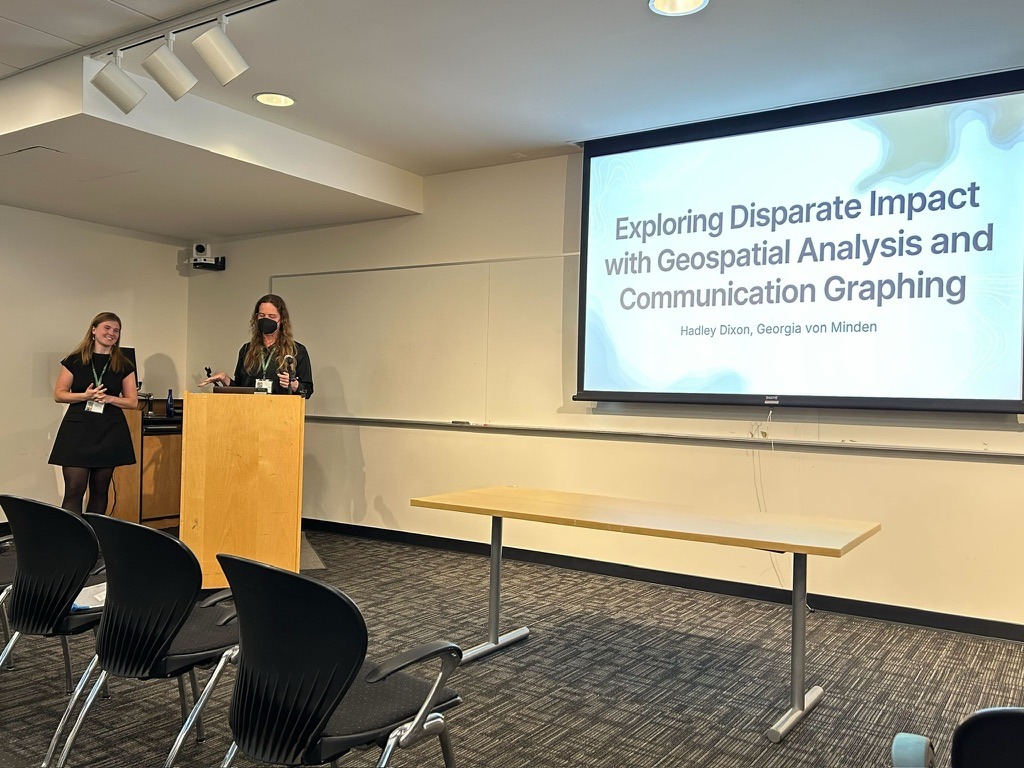
Research Questions
- Where does patrolling occur most intensely?
- How are these activities discussed internally by law enforcement?
- Do patterns show disparate impact on protected communities?
Disparate impact refers to policies or practices that adversely affect one group more than others, even when not intentionally discriminatory.
Geospatial Analysis
Dataset
-
Unit of analysis: Census Block Groups (n=230)
-
Attributes extracted using ArcGIS Pro:
- Demographic: Race/Ethnicity, Poverty Rate, Median Income, English Learner Status, Educational Attainment, Unemployment Rate
- Environmental: Wetland & Watershed Coverage
- Zoning: Residential Housing Density, Private Area, Population Estimates, Homeowner Rate
-
Targets:
- All patrol reports
- Cannabis-flagged patrol reports
(Derived from PRA requests and internal documents)
Modeling
- Model type: Random Forest Regression
- Train/Test split: 184 / 46 block groups
- Goal: Assess if cannabis-related patrols concentrate in specific communities
Results
All Patrol Reports
Test R²: 0.41
Validation R²: 0.52
| Feature | Importance Score |
|---|---|
| Wetland/Watershed | 0.1909 |
| Poverty Rate | 0.1362 |
| Population Estimate | 0.1048 |
| Bachelor’s Attainment | 0.1021 |
| Residential Housing Density | 0.0917 |
Cannabis-Flagged Reports
Test R²: Invalid
Validation R²: 0.44
| Feature | Importance Score |
|---|---|
| Bachelor’s Attainment | 0.2825 |
| Hispanic/Latino | 0.1642 |
| Wetland/Watershed | 0.1640 |
| English Learner Rate | 0.1083 |
| Residential Housing Density | 0.0741 |
SHAP Explanations (Cannabis-Flagged Reports)
| Feature | Mean |SHAP| | Mean SHAP | StdDev |
|---|---|---|---|
| Bachelor’s Attainment | 0.4424 | 0.0545 | 0.9268 |
| English Learner Status | 0.2575 | 0.0045 | 0.5071 |
| Hispanic/Latino | 0.2171 | 0.0365 | 0.4634 |
| Residential Housing Density | 0.1324 | -0.0075 | 0.2714 |
| Wetland/Watershed | 0.0510 | 0.0012 | 0.6608 |
Conclusion: Patterns suggest patrols may be concentrated in areas with higher Hispanic/Latino and English Learner populations, especially for cannabis-related investigations. However, model performance is moderate—results should guide further research, not legal conclusions.
Communication Graphing
Dataset
- ~5,000 internal emails from a law enforcement agency over 4 years
- ~200 employees, multiple teams
- Collected via PRA request
- Unstructured and noisy (non-standard formats)
Methodology
- Latent Dirichlet Allocation (LDA) for topic discovery
- Network graphing to visualize:
- Who discusses which topics
- Topic evolution over time
- Statistical significance testing on topic frequency over time (α = 0.05)
Example Workflow
- Extracted topic: “permit”, “surveillance”, “cannabis”, “dwelling”
- Batch group emails by this topic
- Identify individuals discussing it
- Map topic intensity over time across the org
Results
- “Hot docs” identified through LDA improve investigator efficiency
- Communication networks showed:
- Team- and individual-level differences
- Noticeable shifts after legal action (e.g., lawsuit filing)
- Significant trends in cannabis enforcement topics over time
Conclusion: LDA-based communication modeling provides useful prioritization for litigation teams and supports rapid legal review of internal documents.
Future Directions
-
Modeling improvements:
Use GWR, GAM, and zero-inflated models to improve patrol prediction accuracy. -
Communication modeling enhancements:
Explore graph-based deep learning (e.g., GNNs, GANs) to enrich topic extraction and document prioritization.
Acknowledgements
Special thanks to:
- Robert Clements, USF M.S. in Data Science
- Dylan Verner-Crist and Ian Duke, ACLU of Northern California
This work was supported by the Master’s in Data Science program at the University of San Francisco.
Contact
Hadley Dixon
📧 hadley.dixon22@gmail.com
Georgia von Minden
📧 georgia.vonminden@gmail.com